Travel money
Travel money in Thailand: cash or card?
Carry baht for the day and keep a card for hotels, malls and anything large — the QR code on every counter in Thailand needs a Thai bank account, so as a visitor you are back to the two old methods.
Thai baht (THB, ฿) · figures checked against the sources at the foot of this page
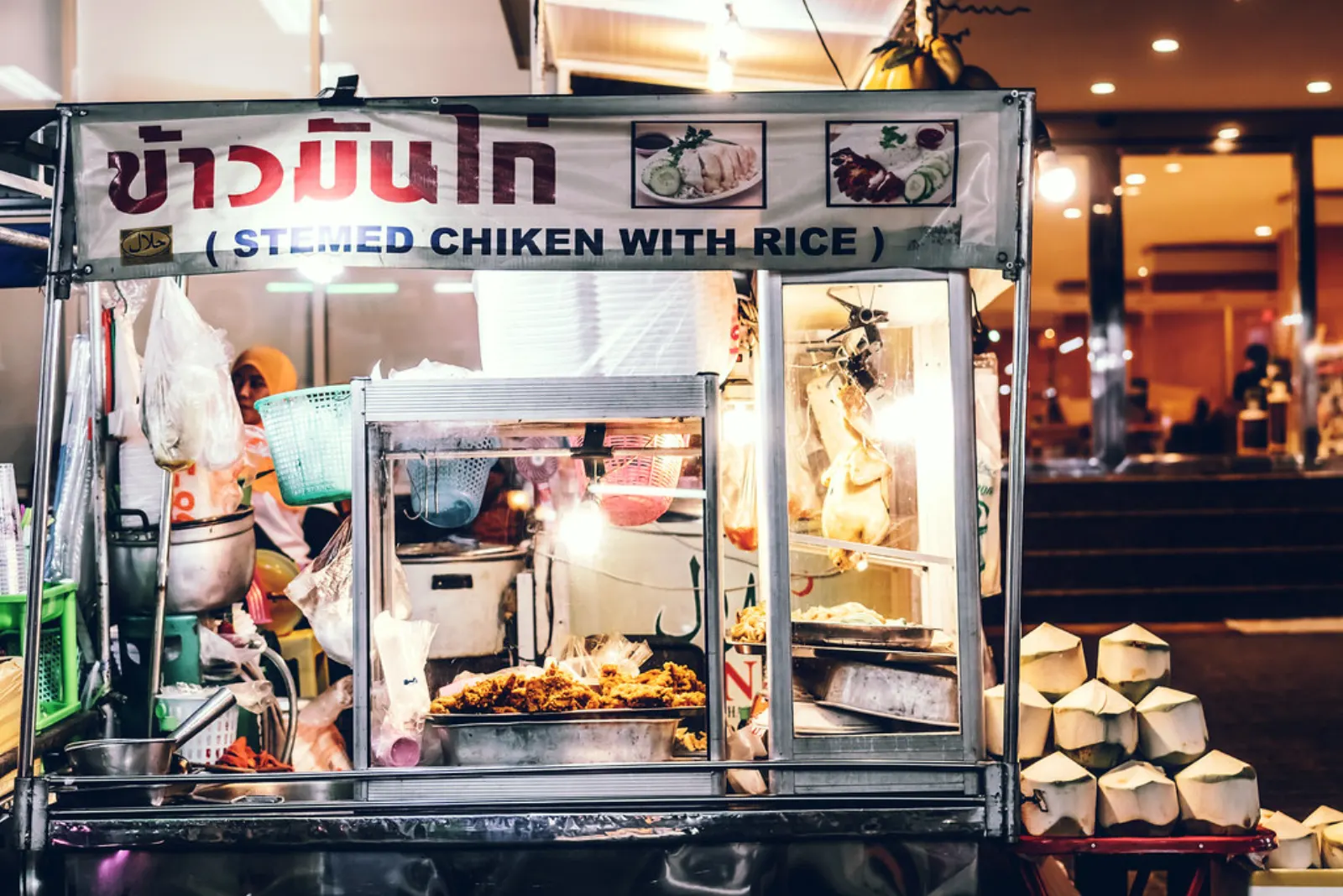
Street food, markets, songthaews, tuk-tuks, small guesthouses, temples, anything outside a city centre.
Hotels, malls, supermarkets, 7-Eleven, chain restaurants and tour desks. Smaller places often add a fee for it.
A day of small notes, plus a card. Break 1,000 ฿ notes at 7-Eleven or a mall — not at a noodle stall.
The ATM's own charge: 220–350 ฿ per withdrawal, taken by the Thai bank before your own bank adds anything.
The money itself
- 20 ฿Green
- 50 ฿Blue
- 100 ฿Red
- 500 ฿Purple
- 1,000 ฿Grey-brown
1, 2, 5 and 10 baht in daily use. The 1 and 2 baht coins are both small and silver and get mixed up constantly; the 10 has a brass centre and is the easy one. Satang coins exist (25 and 50) but prices round to the baht and you will rarely see them.
ATMs pay out in 1,000 ฿ notes, which is the wrong money for most of what you will actually buy. Break one at a 7-Eleven, a supermarket or a mall on the way out — a street vendor holding 200 ฿ of float cannot change it, and both of you will stand there while someone runs next door.
Every way to pay, and whether it works for a visitor
Whether a payment method exists in Thailand and whether you can use it are different questions. This table answers the second one: no local bank account, no local SIM, no residency.
Cash (baht)
WorksNever refused, and the only thing a food stall, a songthaew, a beach bar or a temple donation box takes. What matters is the denomination, not the amount: small notes and coins are what daily life runs on.
Visa / Mastercard
Works, with a catchHotels, malls, supermarkets, 7-Eleven and chain restaurants take them without fuss, contactless included. Smaller guesthouses, dive shops and tour agents frequently pass the card fee on to you, or simply ask for cash.
Often 3–5% added at small merchants
Apple Pay / Google Pay
WorksIt is your own Visa or Mastercard, so it works at any terminal that takes contactless — which by now is most tills in a city. Nothing to register locally, and no Thai wallet involved.
Thai QR / PromptPay
Residents onlyThe QR sticker propped on every counter in the country, from mall chains to a woman selling mango. Scanning it needs a Thai bank account, and Thai banks open those for residents — a tourist cannot register PromptPay.
Your home bank app or wallet, via the QR
Depends where you're fromThe Bank of Thailand runs cross-border QR links, so visitors from Cambodia, Laos, Malaysia, Indonesia, Vietnam, Hong Kong, Korea and China can scan a Thai merchant QR with their own bank app or wallet (Alipay, WeChat Pay and UnionPay included). Arriving from anywhere else, this does not apply to you.
JCB / UnionPay
Works, with a catchWidely handled in tourist areas, hotels and at bank ATMs, and thinner the further you get from them. Fine as a second card, risky as your only one.
American Express
Works, with a catchHotels, department stores and larger restaurants. Below that level, assume it will not be taken.
TrueMoney and other Thai wallets
Residents onlyRegistration needs a Thai SIM to receive the one-time code. A passport-only account, where it is granted at all, tends to be limited to shop payments and cannot scan an ordinary street QR.
Grab / Bolt
WorksBoth accept a foreign card in the app, and both let you pay the driver in cash instead — which most drivers would rather have. Sign-up needs a phone number that can take an SMS code, so set the app up before your home SIM goes quiet.
Cash
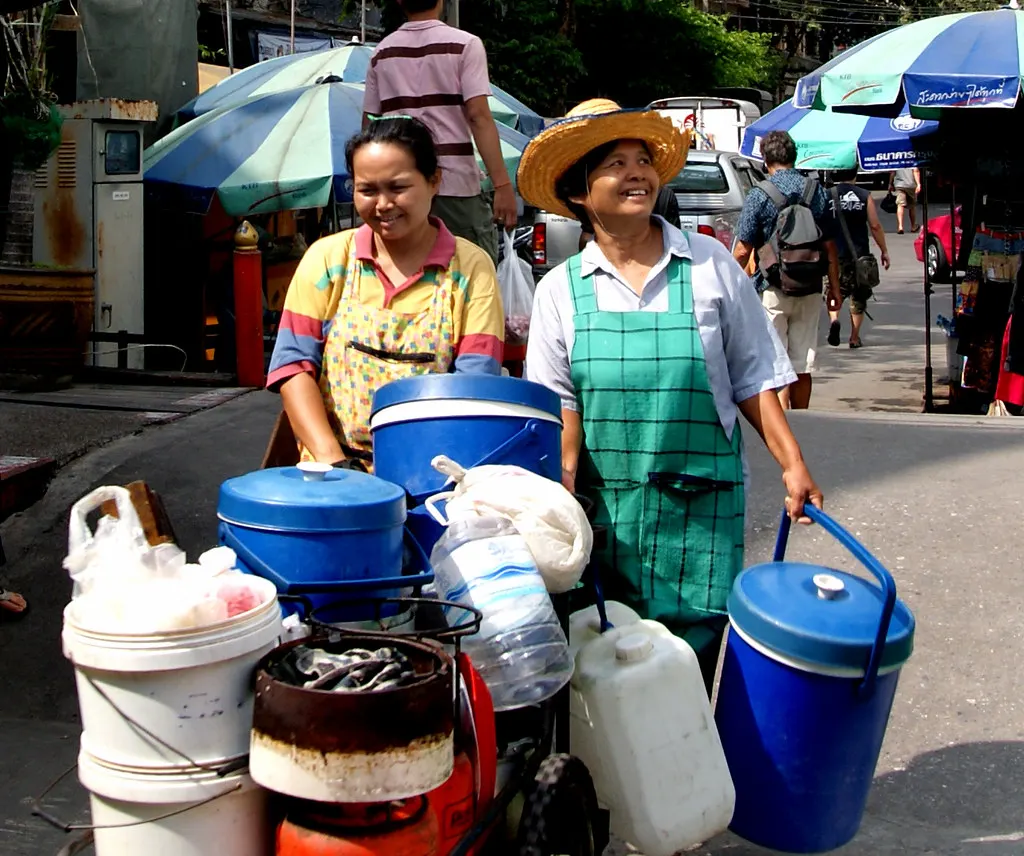
Thailand runs on cash at the bottom end and cards at the top, and the line between them is lower than visitors expect. A 60 ฿ plate of noodles, a 20 ฿ songthaew ride, a bag of fruit, a beach chair, a temple entry, a motorbike day rental in Pai — all cash, all the time, in a country that is otherwise thoroughly digital.
Plan your float around small notes rather than a total. A 1,000 ฿ note is useless at a stall and awkward in a taxi; 20s, 50s and 100s are what you actually spend. Buy something small at a 7-Eleven early in the day and you have solved change for the next few hours.
Cash also removes the surcharge problem. Where a guesthouse or a tour agent adds 3–5% for taking a card, paying in baht is simply cheaper for the same room or the same boat.
Cards
Card acceptance in Thailand is a question about the size of the business, not the city. Malls, hotels, supermarkets, 7-Eleven, cinema chains and anything with a printed menu in English will take a contactless Visa or Mastercard without comment. Family-run restaurants, markets and small guesthouses usually will not.
The catch in the middle is the surcharge. Passing the card fee to the customer breaks the merchant agreement, and small businesses do it anyway — commonly 3–5%, sometimes a flat 100 ฿, most often at guesthouses, dive shops and tour agencies. It is normally mentioned only at the moment you hand the card over, so ask when you agree the price rather than when you pay.
Whatever you pay with, decline the offer to be billed in your own currency. A terminal that shows your home-currency total is running dynamic currency conversion, and the rate it uses is chosen by the merchant's processor rather than by Visa or Mastercard. Choosing baht is the only way to get the network rate.
ATMs
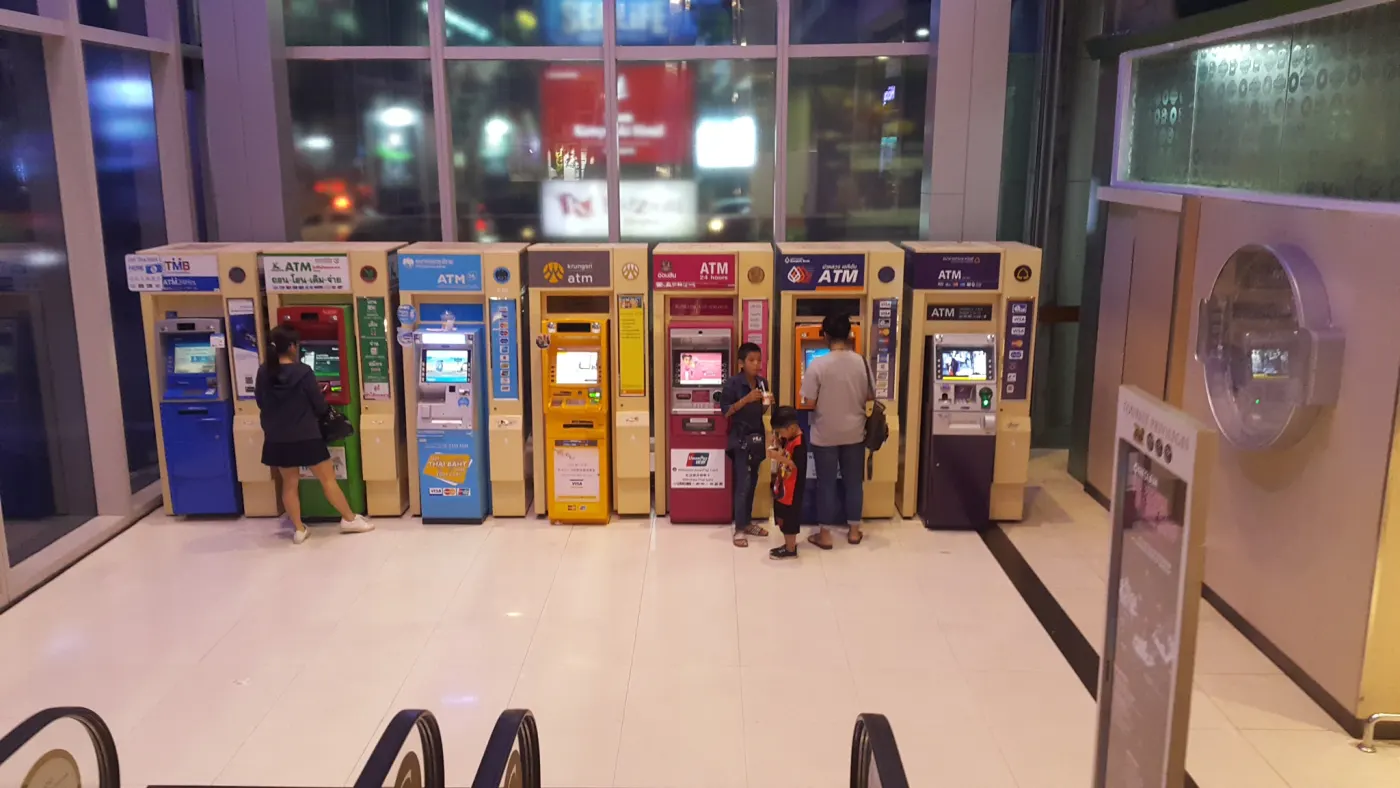
Every Thai bank charges foreign cards a fixed fee per withdrawal, taken by the machine and separate from anything your own bank charges. It sat at 220 ฿ for years; through 2025 and 2026 machines have been displaying 250 ฿, and 350 ฿ on some Mastercard withdrawals. It varies by bank, by card network and by machine, so the number on the screen is the only one that counts — and it appears before you confirm, which makes it worth reading rather than tapping through.
Because the fee is fixed per withdrawal rather than a percentage, the arithmetic is simple: fewer, larger withdrawals cost less. Taking out a week of spending in one go and keeping it somewhere sensible beats a daily top-up by whatever the fee is, multiplied by the days you did not need to withdraw.
The machine will also offer to convert the amount for you, usually as a 'with conversion / without conversion' choice, and often with a scary-looking warning attached to the correct answer. Decline the conversion. Take the baht amount and let your own bank do the exchange.
Changing money
Baht is one of the easier currencies to hold cash in: exchange booths are everywhere in Bangkok, Chiang Mai and the tourist islands, they are open late, and the good ones charge no commission and post their rates on a board outside. Bring clean, unfolded notes — a torn or heavily marked foreign note gets a worse rate or gets refused.
Where you change matters more than what you change. Airport arrival counters and hotel desks price for convenience; the dedicated exchange chains a couple of BTS stops into town, SuperRich and Vasu among them, are the benchmark, and the gap between the two can run to a few per cent of the whole amount. Change a small amount at the airport for the taxi and the first day, then the rest downtown.
Whether exchanging beats an ATM depends entirely on how much you are moving. The ATM's fixed fee is brutal on small withdrawals and mild on large ones; a booth's spread is proportional, so it stays the same in percentage terms whatever you hand over. Carrying some cash from home and withdrawing the rest in big chunks covers both.
Costs that are not the price
Service charge, then VAT
Mid-range and upmarket restaurants and hotels add a 10% service charge, and 7% VAT is applied on top. Both are printed at the foot of the bill, and both are legitimate — but a bill that already carries the service charge is not asking for a tip as well.
Tipping is optional and small
Nothing is expected. The normal gestures are rounding the taxi fare up to the next note, leaving the coins from your change, 20–100 ฿ for good service where there was no service charge, and 50–100 ฿ after a massage. Nobody will chase you for more.
The card surcharge
Small guesthouses, dive shops and tour agents often add 3–5% to pay by card, occasionally a flat fee instead. Ask when you agree the price: it is the one charge here you can remove entirely by paying cash.
Dual pricing at parks and attractions
National parks, and some temples and museums, publish one price for Thais and a higher one for foreigners — 400 ฿ at the busiest parks against a fraction of that locally. It is official policy printed on the board, not a scam being run on you at the gate, and it belongs in the budget for any island or park day.
You can claim the 7% VAT back on goods
Shops displaying the blue 'VAT Refund for Tourists' sign will issue a P.P.10 form against your passport if you spend at least 2,000 ฿ there in a day. Keep the original tax invoices, take the goods out with you within 60 days, and claim at the refund counter at an international airport before you fly. Processing fees mean you get back a little under the full 7%.
Paying for transport
The MRT takes your card at the gate
The Blue, Purple, Yellow and Pink lines accept EMV contactless, including foreign Visa and Mastercard: tap in, tap out, fare calculated automatically. Use the same physical card at both ends — tapping in with the phone and out with the plastic is what causes the gate to argue.
The BTS Skytrain does not
No contactless on the Green and Gold lines. Either buy a Rabbit card at a ticket office (200 ฿, of which 100 ฿ is the card itself and 100 ฿ is travel credit) or use the single-journey machines, which take cash only — coins and 20, 50 and 100 ฿ notes.
Taxis, tuk-tuks and songthaews
Cash, in small notes. Bangkok taxis have meters and should use them; tuk-tuks and songthaews are a price agreed before you get in. Grab and Bolt are the way to pay by card for a ride, and even there most drivers would rather take the cash.
What you may carry in and out
Taking baht out
Up to 50,000 ฿ per person to most countries, and up to 2,000,000 ฿ if you are travelling to a country bordering Thailand, Vietnam, or Yunnan in China. Baht above 450,000 ฿ has to be declared to customs in either direction.
Foreign notes in and out
There is no limit on bringing foreign currency in. The Bank of Thailand currently puts the customs declaration threshold for foreign banknotes at USD 15,000 or equivalent, while older guidance still circulates saying USD 20,000 — if you are near either figure, declare and be done with it.
Common questions about money in Thailand
Can tourists use PromptPay or QR payments in Thailand?
Not with a Thai account — PromptPay registration needs a Thai bank account, and those are for residents. There is one exception: if you are visiting from Cambodia, Laos, Malaysia, Indonesia, Vietnam, Hong Kong, Korea or China, the Bank of Thailand's cross-border links let you scan Thai merchant QR codes with your own bank app or wallet. Everyone else pays cash or card.
Should I bring cash to Thailand or withdraw baht there?
Both work, and the split depends on amounts. Thai ATMs charge a fixed 220–350 ฿ per withdrawal, so small, frequent withdrawals are the expensive way to do it; exchange booths in town charge a spread instead, which stays proportional. Bring some cash for the arrival and the first day, exchange the bulk at a downtown booth rather than the airport, and withdraw in large chunks if you top up.
How much is the ATM fee in Thailand?
The Thai bank that owns the machine charges a fixed fee per foreign-card withdrawal, on top of whatever your own bank charges. It was 220 ฿ for years and machines now commonly display 250 ฿, with 350 ฿ appearing on some Mastercard withdrawals. It differs by bank and network, and the screen shows the exact figure before you confirm.
Can I pay by card in Thailand?
In hotels, malls, supermarkets, 7-Eleven and chain restaurants, yes, contactless included. Street food, markets, songthaews and small guesthouses are cash. In between, plenty of small businesses take cards but add 3–5% for it, so ask before you agree a price.
Can I use Apple Pay or Google Pay in Thailand?
Yes, anywhere a contactless terminal is in use, because it is simply your own Visa or Mastercard. It gives you nothing extra at the places that only take cash, and it does not let you scan a Thai QR code.
In Thailand, should I pay in baht or my own currency?
In baht, every time. When a card terminal or an ATM offers to charge you in your home currency, that is dynamic currency conversion: the merchant's processor sets the rate instead of Visa or Mastercard, and it is reliably worse than the one you would otherwise have got.
Do I need cash in Bangkok?
Yes, even though Bangkok is the most card-friendly place in the country. The BTS Skytrain ticket machines take cash only, street food is cash, and so is every taxi that is not booked through an app. A modest float in small notes covers all of it.
Where these figures come from
Checked against the following on . Fees and thresholds move; where a figure varies by bank or by machine, this page gives the range rather than inventing a single number.