Travel money
Travel money in Morocco: cash or card?
The dirham is a closed currency: you get it on arrival, you spend it before you leave, and you keep the exchange receipts. Cash runs the souks and the small places; cards stop at the hotel door.
Moroccan dirham (MAD, DH) · figures checked against the sources at the foot of this page
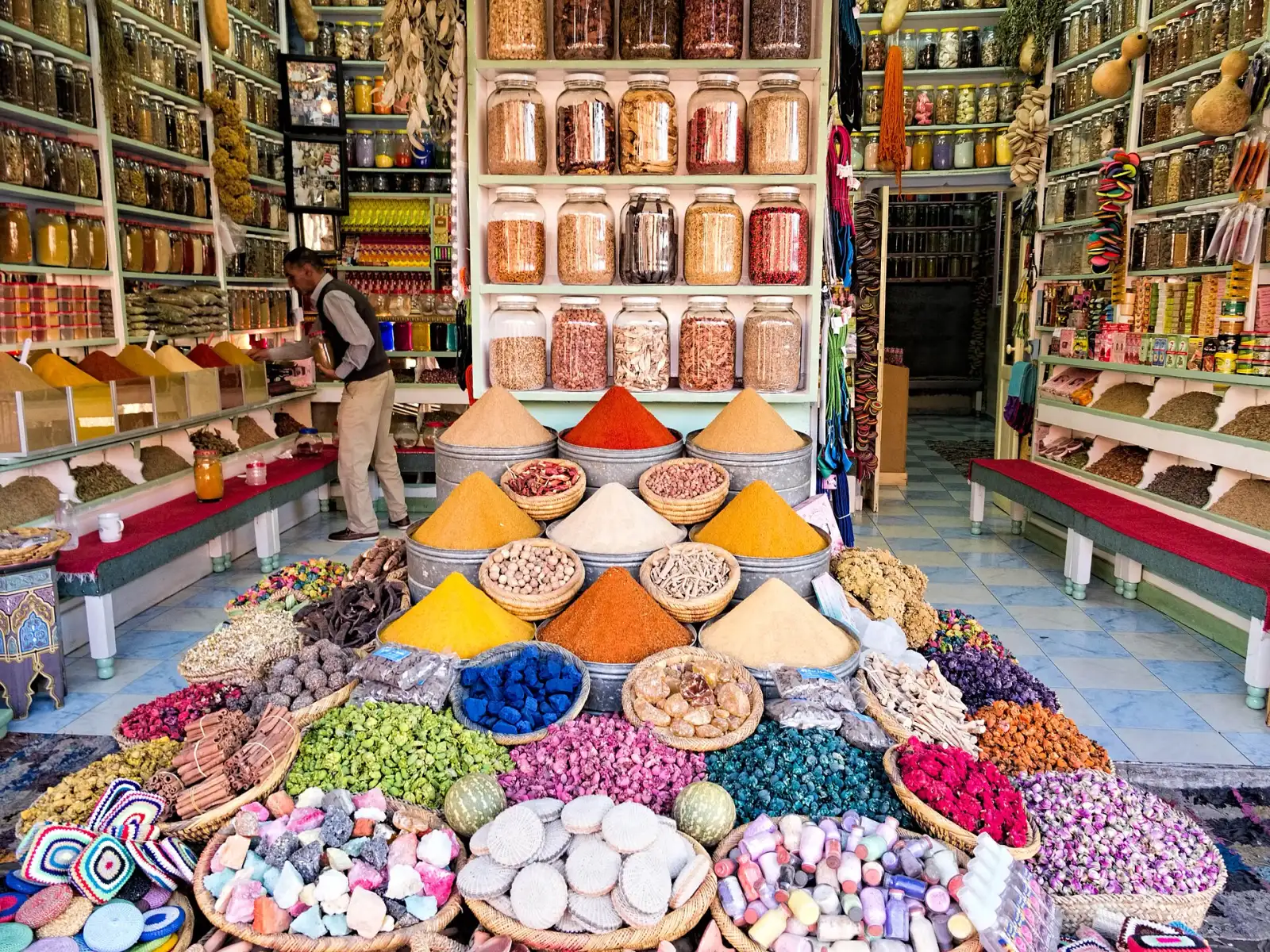
Souks, taxis, cafés, riads outside the cities, guides, hammams, and every tip you will give.
Hotels, larger riads, supermarkets, chain restaurants and the bigger shops in Marrakesh, Casablanca and Fes.
A working float in dirhams, in small notes — and the receipts from wherever you got them.
Leaving with dirhams. The export limit is small, and changing back can need proof of the original exchange.
The money itself
- 20 DHPurple-red
- 50 DHGreen
- 100 DHBrown
- 200 DHBlue
½, 1, 2, 5 and 10 dirhams, plus centimes. Coins matter here: a petit taxi, a mint tea, a hammam and every tip are coin-sized, and a note handed to a parking attendant will not come back with change.
Prices are quoted in dirhams but you will hear rial in older markets — an informal unit worth a twentieth of a dirham, so a price of a hundred rial is five dirhams. It is not a trick, it is an older way of counting, and asking for the price in dirhams settles it immediately.
Every way to pay, and whether it works for a visitor
Whether a payment method exists in Morocco and whether you can use it are different questions. This table answers the second one: no local bank account, no local SIM, no residency.
Cash (dirhams)
WorksThe default everywhere and the only thing that works in the souks, in petit taxis, at hammams, with guides, at roadside cafés and in the smaller towns. Small notes and coins do most of the work.
Visa / Mastercard
Works, with a catchFine at hotels, larger riads, supermarkets, chain restaurants, petrol stations and the bigger shops in the main cities. In the medina it is the exception, and where a card is taken a surcharge sometimes appears with it.
Apple Pay / Google Pay
Works, with a catchWorks where a contactless terminal exists, which is a small and city-bound set. It inherits your card, so it does not help where cards are refused.
Euros and dollars
Works, with a catchSome tourist businesses accept them at a rate of their choosing, and change comes back in dirhams. As a way to pay it is expensive; as something to change at a bureau it is exactly what to bring.
Moroccan payment apps
Residents onlyDomestic wallets and bank apps run on Moroccan accounts and identity documents. Nothing a visitor needs requires one.
Cash
Morocco is cash-first in the places you came to see. The souks of Marrakesh and Fes, the petit taxis, the mint tea, the hammam, the guide, the man who helps you park — all of it is dirhams in hand, usually in small notes and coins.
Cards cover the formal layer: hotels, larger riads, supermarkets, chain restaurants, petrol stations. Between the two, plan for a proper daily float rather than a token one, and keep small denominations, since a 200 dirham note is difficult in a medina and impossible for a tip.
Withdraw at bank machines rather than at the airport counter — but withdraw deliberately, because most Moroccan banks now charge a fee per withdrawal of around 35 dirhams against a per-transaction cap that is often only 2,000.
Cards
Card acceptance follows formality and geography: the more established the business and the bigger the city, the likelier the terminal. Marrakesh, Casablanca, Rabat, Tangier and Fes have plenty; a mountain village or a desert camp does not.
Where cards are accepted, some businesses add a fee for using one, and it is usually mentioned only at the point of paying. Ask before a large payment — a tour, a rug, several nights of accommodation.
Decline dynamic currency conversion at terminals and machines. Being billed in euros or pounds hands the rate to the merchant's processor and costs several percent on top of the withdrawal fee you are already paying.
ATMs
Nearly every Moroccan bank now charges foreign cards an access fee — commonly 35 dirhams — and the per-transaction cap at many machines is 2,000. That combination is the expensive part: a flat fee against a low ceiling is a high percentage, and there is no way around it except taking the maximum each time.
Machines belonging to the larger banks in cities are reliable; in small towns they can be empty, offline or absent. Withdraw before heading into the Atlas, the desert or the smaller coastal towns rather than after.
Keep the receipts. They are the paperwork that lets you convert leftover dirhams back at the airport, and the machine slip is easier to produce later than you expect.
Changing money
The dirham is a closed currency, which is the single most consequential fact on this page. You cannot buy it meaningfully before you travel, so plan to arrive with euros or dollars in clean notes and change them here, or to withdraw on arrival.
Change at banks or licensed bureaux, which are common in the cities and at the airports, and keep every receipt. Converting dirhams back on the way out is allowed, but the counter can ask for proof that you exchanged the money legitimately in the first place, and without it you may be stuck.
The legal limit on carrying dirhams across the border is small — a couple of thousand — so treat the last day as the day to spend down. Attempting to leave with a pile of undeclared, unexplained dirhams risks confiscation rather than a shrug.
Costs that are not the price
Tipping is constant and small
Around 10% in restaurants where no service charge appears, a few dirhams for the café waiter, coins for the parking attendant and the hammam, and 100–200 dirhams a day for a guide. It is a steady stream of small amounts rather than an occasional gesture, which is the real reason to keep coins.
Bargaining is the price mechanism
In the souks the first number is an opening position, not a price, and cash is what closes the gap. In shops with printed prices it does not apply at all. Neither is rudeness; knowing which situation you are in is the whole skill.
You can reclaim VAT if you live abroad
Non-residents can claim on purchases of 2,000 dirhams or more from the same seller on the same day, with the form validated by customs on departure. Food, tobacco, medicines and unset stones are excluded, and VAT is 20% before the operator's cut.
Guides, official and otherwise
Official guides are licensed and priced by the day; unofficial ones attach themselves in medinas and expect payment for directions you did not ask for. Agreeing a price and a duration before setting off is the norm and avoids the argument at the end.
Paying for transport
Trains are the good news
ONCF sells tickets at stations and online by card, and the Al Boraq high-speed line between Tangier and Casablanca is genuinely fast and inexpensive. Booking ahead matters on holidays and Fridays.
Taxis are negotiated or metered
Petit taxis inside a city should use the meter and often need reminding; grand taxis between towns run a fixed price per seat, agreed before you get in. Both are cash. Careem and inDrive operate in the larger cities and quote in the app.
Buses and the desert
CTM and Supratours sell online and at stations by card, and are the comfortable option between cities. A desert tour is quoted as a package, frequently in euros, and the balance is often expected in cash.
What you may carry in and out
Dirhams cannot leave with you
The dirham is a closed currency and only a small amount — around 2,000 — may legally be carried across the border. Spend down, or convert back before departure with your exchange receipts to hand.
Declaring foreign cash
Foreign currency above the equivalent of 100,000 dirhams must be declared on arrival, and declaring it is what allows you to take it out again.
Common questions about money in Morocco
Can I get Moroccan dirhams before I travel?
Not meaningfully. The dirham is a closed currency, so it is neither sold nor bought at a sensible rate outside Morocco. Bring euros or dollars in clean notes to change on arrival, or withdraw from a bank machine at the airport.
Can I take dirhams out of Morocco?
Only a small amount — around 2,000 dirhams. Anything more should be spent or converted back before you leave, and the exchange counter can ask for the receipts from when you originally changed or withdrew the money, so keep them.
How much are ATM fees in Morocco?
Most banks now charge around 35 dirhams per withdrawal, with some between 22 and 50, and the per-transaction cap is often only 2,000 dirhams. That combination makes cash expensive here, so take the maximum the machine allows and withdraw in cities rather than small towns.
Do I need cash in Morocco?
Yes, daily. Souks, petit taxis, cafés, hammams, guides, parking attendants and tips are all cash, and small notes and coins matter more than the total. Cards cover hotels, supermarkets and larger restaurants in the main cities.
How much should I tip in Morocco?
Around 10% in restaurants, a few dirhams for café service and parking attendants, and 100–200 dirhams a day for a guide. Tipping is frequent and small rather than occasional and large, which is why coins are worth keeping.
Can I pay in euros in Morocco?
Some tourist businesses will take them at a rate they choose, and your change comes back in dirhams. It is a poor deal as a payment method, though euros are exactly the right currency to bring for changing at a bank or bureau.
Can I claim VAT back in Morocco?
If you live abroad, on purchases of 2,000 dirhams or more from one seller on the same day, validated by customs on your way out. Food, tobacco, medicines and unset precious stones are excluded from the scheme.
Where these figures come from
Checked against the following on . Fees and thresholds move; where a figure varies by bank or by machine, this page gives the range rather than inventing a single number.