Travel money
Travel money in South Korea: cash or card?
One of the most card-friendly countries anywhere: your own card covers nearly everything, a transit card covers the rest, and the tax refund often happens at the till instead of at the airport.
South Korean won (KRW, ₩) · figures checked against the sources at the foot of this page
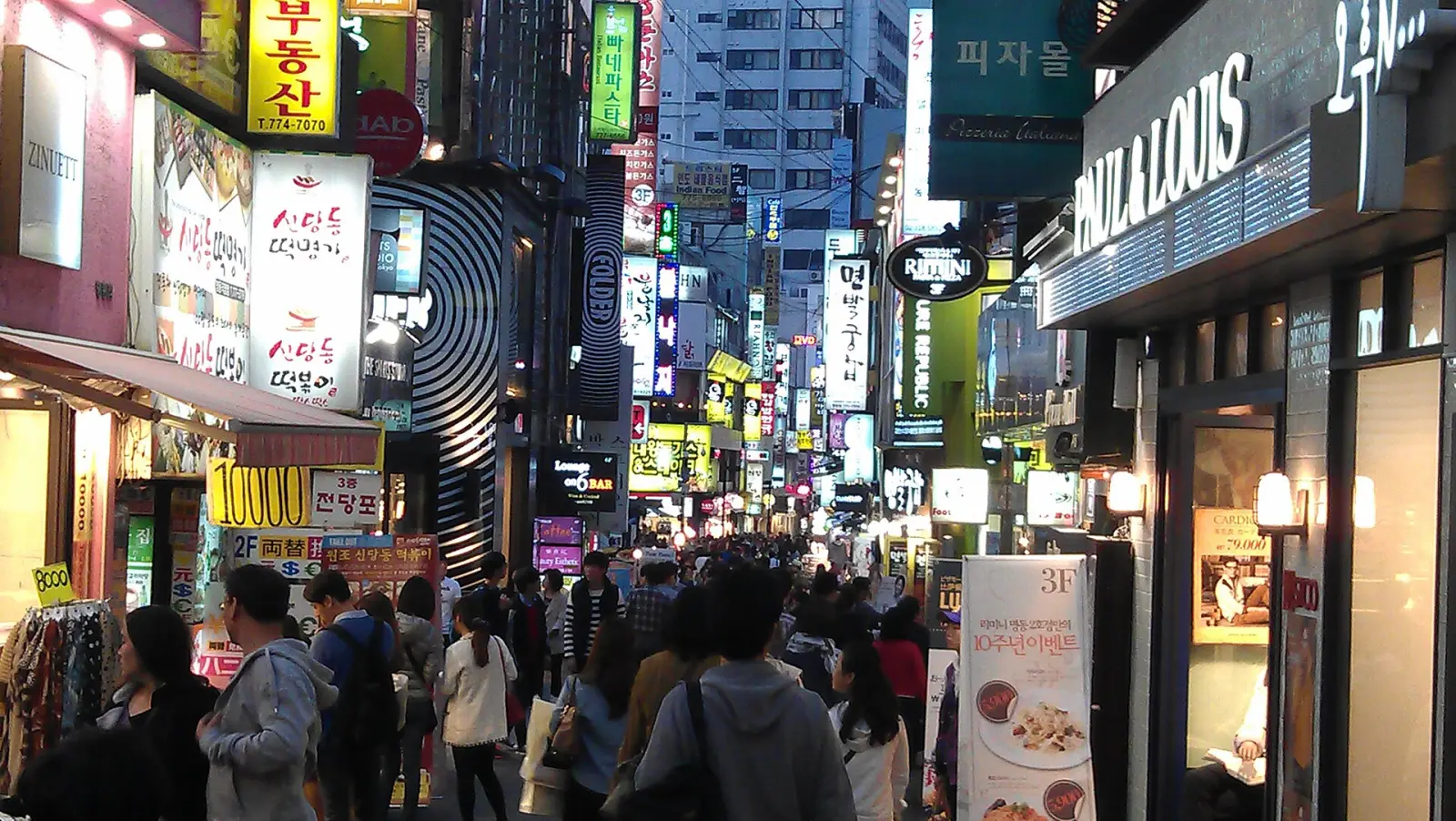
Traditional markets, street food carts, a few small family places, and rural towns.
Everything else, contactless included — down to a convenience-store coffee.
₩50,000 or so for markets, plus a transit card. Most days you will not open the notes.
Reaching a market stall with only a card. Gwangjang and its like are the one cash-shaped hole.
The money itself
- 1,000 ₩Blue
- 5,000 ₩Red-orange
- 10,000 ₩Green
- 50,000 ₩Yellow-brown
10, 50, 100 and 500 won. They accumulate from market change and from the deposit machines, and they are worth keeping for coin lockers at stations, which are genuinely useful when you are moving between cities.
The ₩50,000 note is the largest and rarely a problem, but a street cart at a night market can still be short of change early in the evening. Break one at a convenience store on the way rather than at the first stall you want to buy from.
Every way to pay, and whether it works for a visitor
Whether a payment method exists in South Korea and whether you can use it are different questions. This table answers the second one: no local bank account, no local SIM, no residency.
Visa / Mastercard
WorksAccepted almost everywhere, contactless included, down to very small amounts. Korea moved to cards early and thoroughly; a convenience store or a café will take a tap without comment.
T-money or a transit card
WorksThe card that pays for every subway and bus in the country, and doubles as small change at convenience stores. Buy one at any convenience store and top it up with cash; station kiosks increasingly take foreign cards for the top-up too.
WOWPASS
WorksA prepaid card built for visitors: load it with foreign banknotes at a machine in a station or airport, and it works as a Korean debit card with T-money transit built in. It is the closest thing here to being handed a local account for the length of a trip.
Apple Pay / Google Pay
Works, with a catchApple Pay works at a growing but incomplete set of merchants, and an iPhone with a Mastercard can now carry a mobile transit card. Google Pay is effectively absent. Bring the plastic as well as the phone.
Cash (won)
WorksAlways accepted and genuinely needed at traditional markets, street food carts and some family-run places. Everywhere else it is optional.
KakaoPay, Naver Pay and Samsung Pay
Residents onlyWhat Koreans actually tap and scan, all built on a Korean bank account, phone number and resident registration. WOWPASS exists precisely because they are closed to visitors.
Cash
Korea is close to cashless in daily life. A card covers convenience stores, cafés, restaurants, taxis, department stores and museums, and small amounts are not a problem — nobody blinks at a card for a ₩2,000 coffee.
The exception is the traditional market, which is exactly where a visitor wants to eat. Gwangjang, Tongin, Jagalchi and their equivalents are still a cash economy in large part, along with street carts and some older family restaurants. ₩50,000 covers a lot of that.
Withdraw at a convenience store rather than hunting for a bank: machines marked Global ATM inside 7-Eleven, GS25, CU and Emart24 take foreign cards around the clock and charge roughly ₩3,000–5,000 a withdrawal. A domestic-only machine will simply refuse your card, which is a network limitation rather than a fault.
Cards
Acceptance is close to universal and contactless is normal. The friction that remains is the reverse of most countries: a Korean terminal sometimes wants a signature or an extra confirmation for a foreign card, and a very small number of older systems handle only domestic cards.
Apple Pay arrived late here and its acceptance is still patchy rather than universal, so a phone alone is not a plan. Carry the card.
Decline any offer to bill you in your own currency. Paying in won and letting your bank convert is always cheaper.
ATMs
Look for the Global ATM sticker. Machines inside 7-Eleven, GS25, CU and Emart24 take international Visa and Mastercard, run in English, and are open whenever the shop is — which is always. The fee is a small fixed amount disclosed on screen.
Bank-branch machines are more likely to be domestic-only and to keep banking hours, so the convenience store is both easier and more reliable. If a machine rejects your card without explanation, that is usually what happened.
Because cards work nearly everywhere, one withdrawal for market food is often the whole trip's cash requirement.
Changing money
Exchange counters in Myeongdong and around the tourist districts are competitive and quick, and generally beat both banks and the airport. WOWPASS machines take foreign notes and load them onto the card, which is exchange and payment in one step.
Airport counters are the expensive option and rarely necessary — there is a machine or a convenience-store ATM on the way into the city.
Won is easy to change back at the airport if you overshoot, but coins are not. Spend the coins on a locker or a convenience store before you fly.
Costs that are not the price
Do not tip
Tipping is not part of the culture and attempting it causes genuine confusion. Menu prices include service, and staff are paid a wage rather than topped up by customers. This holds in restaurants, taxis, hotels and shops alike.
The tax refund often happens at the till
Purchases from about ₩15,000 at a participating shop qualify, and many stores now deduct the tax immediately so you simply pay less — no forms, no airport queue. Larger purchases and non-participating shops still route through a kiosk before check-in, so keep the receipts.
Prices include tax
VAT is inside the displayed price, so what you read is what you pay. Restaurants do not add service charges either.
Coin lockers and deposits
Station lockers, some drinks bottles and a few markets run on coins and small deposits. It is the one reason to keep the change rather than round it away.
Paying for transport
One card, the whole country
T-money and its equivalents work on subways and buses in Seoul, Busan, Daegu, Incheon and beyond, and the transfer discounts only apply if you tap in and out with the same card. It also pays at convenience stores, which makes the leftover balance easy to spend.
Trains are booked by card
KTX and the rest sell online and at station machines, and reserved seats on busy routes go early on holiday weekends. Buying at the station is straightforward with a foreign card.
Taxis take cards, and the apps take them too
Every taxi accepts cards and transit cards. Kakao T is the local ride app and can be awkward for visitors without a Korean number, which is one more reason the transit card earns its place.
What you may carry in and out
Declaring cash
More than USD 10,000 or the equivalent in cash and instruments must be declared to customs when entering or leaving Korea.
Won leaves easily enough
There is no practical restriction on carrying won out within the declaration limit, and it changes back readily at the airport — coins excepted.
Common questions about money in South Korea
Do I need cash in South Korea?
A little, mostly for traditional markets and street food carts. Cards cover convenience stores, cafés, restaurants, taxis and shops down to tiny amounts. ₩50,000 in notes is a sensible reserve for a week.
What is WOWPASS and is it worth it?
A prepaid card made for visitors: feed foreign banknotes into a machine at a station or airport and it becomes a Korean debit card with transit built in. It is worth it if you want one card for everything, and it neatly solves both the exchange and the transit-card problems in a single step.
Can I tap my own bank card on the Seoul subway?
Not at the gate as a rule — the subway runs on T-money and its equivalents. Buy a transit card at any convenience store and top it up with cash, or use WOWPASS, which carries the transit balance. Station kiosks increasingly take foreign cards for top-ups, and an iPhone with a Mastercard can now hold a mobile transit card.
Which ATMs in Korea take foreign cards?
Those marked Global ATM, found in 7-Eleven, GS25, CU and Emart24. They run in English, are open around the clock and charge roughly ₩3,000–5,000. Many bank-branch machines are domestic-only and will decline a foreign card outright.
Should I tip in South Korea?
No. Tipping is not customary and trying to leave one usually causes confusion. Prices include service and there are no service charges on restaurant bills.
How does the Korean tax refund work?
Purchases from around ₩15,000 at participating shops qualify, and many now deduct the tax at the till so you simply pay less on the spot. Where that does not happen, keep the receipts and use a refund kiosk at the airport before checking in.
Does Apple Pay work in Korea?
Partly. It arrived late and acceptance is still incomplete, so it works at many chains and fails at others. Google Pay is effectively absent. Carry the physical card as well as the phone.
Where these figures come from
Checked against the following on . Fees and thresholds move; where a figure varies by bank or by machine, this page gives the range rather than inventing a single number.